
Description
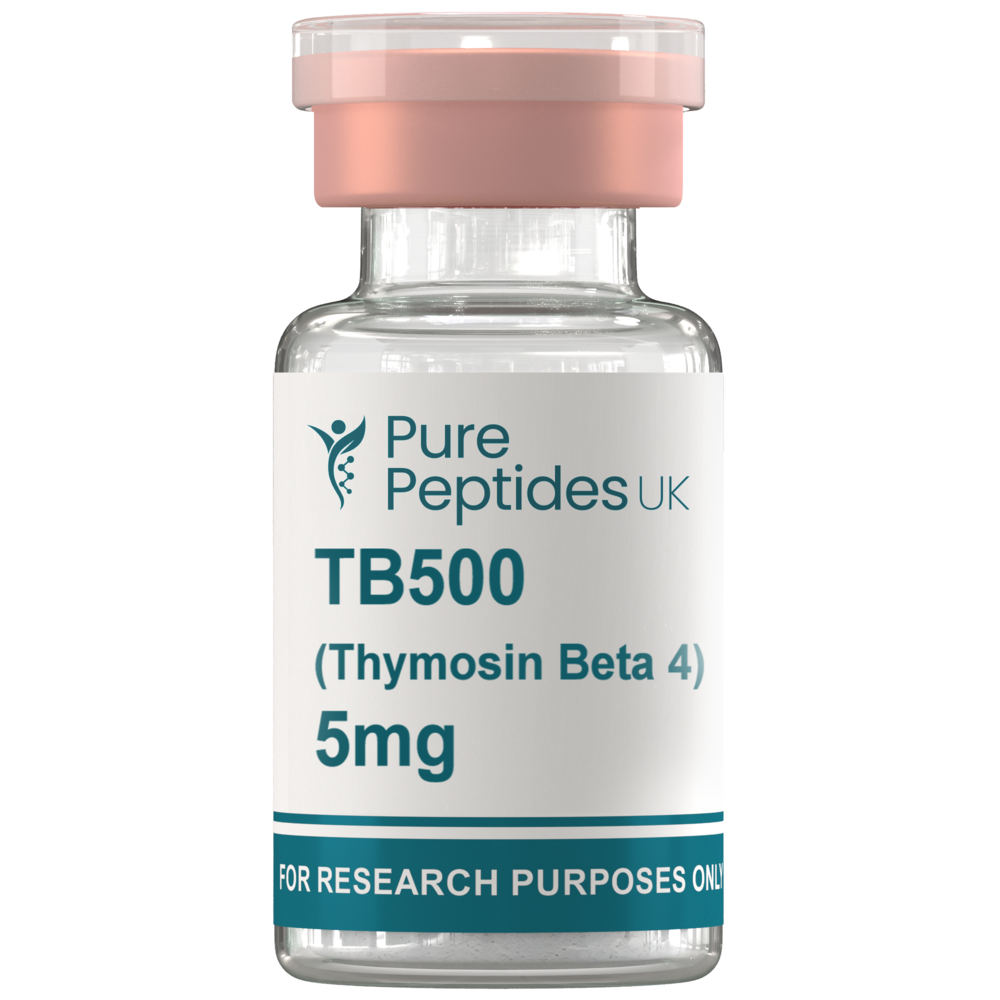
Thymosin Beta-4 (TB500) 5mg
Product Overview
Thymosin Beta-4 (commonly referred to as TB500 in its synthetic form) is a peptide that has become a significant subject of interest in laboratory research focused on cellular repair, tissue regeneration, and actin regulation. TB500 is the synthetic analogue of the naturally occurring peptide Thymosin Beta-4, which is present in nearly all human and animal cells.
Due to its broad involvement in fundamental cellular processes, TB500 is widely studied in controlled research environments investigating tissue dynamics, inflammatory pathways, and cellular migration.
Understanding Thymosin Beta-4 (TB500)
TB500 is a 43-amino-acid peptide involved in the regulation of actin, a protein essential for cell structure, movement, and division. Actin plays a critical role in wound repair, muscle tissue maintenance, and cellular signalling, making TB500 a compelling compound for experimental research.
Naturally occurring Thymosin Beta-4 is found in a variety of tissues throughout the body, including muscle tissue, blood cells, and areas undergoing repair. The synthetic TB500 peptide allows researchers to study these processes in a controlled laboratory setting.
Mechanism of Action (Research Context)
In research models, TB500 is associated with:
-
Regulation of actin polymerisation
-
Support of cell migration and differentiation
-
Involvement in angiogenesis (new blood vessel formation)
-
Modulation of inflammatory signalling pathways
These mechanisms make TB500 particularly relevant in studies examining tissue regeneration, inflammation, and cellular repair processes.
Areas of Research Interest
Current laboratory research involving TB500 explores its potential role in:
-
Tissue repair and regeneration pathways
-
Muscle and connective tissue research
-
Inflammatory response modulation
-
Cellular migration and proliferation
-
Angiogenesis-related studies
-
Hair follicle biology research
All research applications remain experimental and are conducted strictly within laboratory environments.
Conclusion
Thymosin Beta-4 (TB500) is a versatile peptide of significant interest in biochemical and cellular research. Its involvement in actin regulation, tissue repair, and inflammatory pathways positions it as a valuable research tool for studying fundamental biological processes. As scientific exploration continues, TB500 remains a prominent peptide within regenerative and cellular biology research.
Technical Details
-
Synonyms: Thymosin Beta-4, Tβ4, Beta-Thymosin 4, Timbetasin
-
Sequence: SDKPDMAEIEKFDKSKLKKTETQEKNPLPSKETIEQEKQAGES
-
IUPAC Condensed: Ser-Asp-Lys-Pro-Asp-Met-Ala-Glu-Ile-Glu-Lys-Phe-Asp-Lys-Ser-Lys-Leu-Lys-Lys-Thr-Glu-Thr-Gln-Glu-Lys-Asn-Pro-Leu-Pro-Ser-Lys-Glu-Thr-Ile-Glu-Gln-Glu-Lys-Gln-Ala-Gly-Glu-Ser
-
Molecular Weight: ~4,963 g/mol
-
CAS Number: 77591-33-4
-
PubChem CID: 16132341
-
Reference: PubChem Link
Storage & Stability
-
Stability: Store lyophilised peptide at -20 °C.
-
After reconstitution, aliquot to avoid repeated freeze–thaw cycles.
-
Reconstituted peptide may be stored at 4 °C for a limited period.
-
Lyophilised material remains stable until expiry when stored at -20 °C.
-
Source: Biosynthesis
-
Reconstitution: Reconstitute with bacteriostatic water.
Usage Disclaimer
This product is supplied for laboratory research purposes only.
Thymosin Beta-4 (TB500) sold by Pure Peptides UK is intended exclusively for scientific research and educational use. Purchase and use are restricted to licensed researchers.
Reviews
There are no reviews yet