
Description
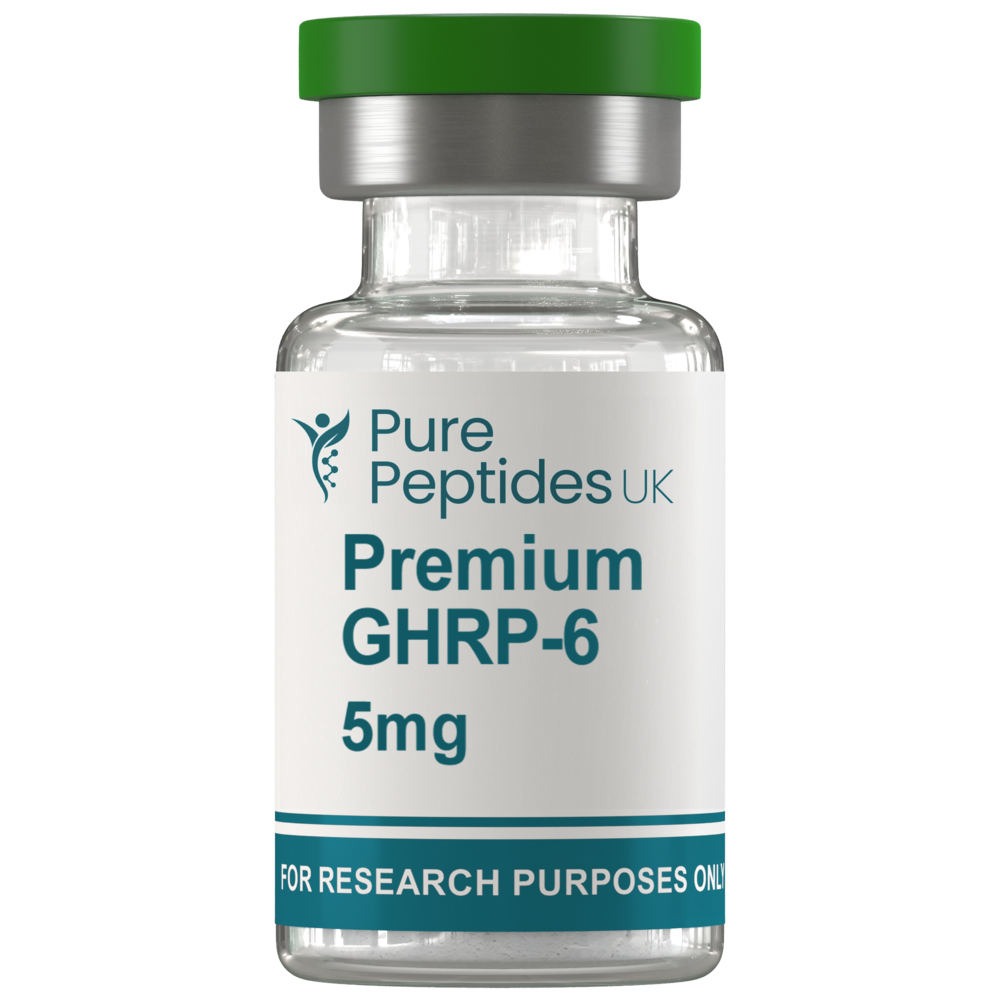
Premium GHRP-6 5 mg
Overview
GHRP-6 (Growth Hormone-Releasing Peptide-6) is a synthetic hexapeptide developed to stimulate the endogenous release of growth hormone (GH) from the pituitary gland. It is one of the earliest and most widely studied members of the growth hormone secretagogue (GHS) family.
GHRP-6 acts on both the hypothalamus and pituitary gland, where it interacts with the ghrelin receptor (GHS-R1a) to trigger the pulsatile release of GH. This mechanism makes it an important peptide for research into GH-axis regulation, metabolic signalling, and appetite modulation.
Scientific Background
GHRP-6 belongs to a class of synthetic met-enkephalin analogues designed to mimic the effects of naturally occurring GH-releasing factors. It has been extensively used in endocrine research to study the physiological control of GH secretion, ghrelin-related signalling pathways, and energy balance mechanisms.
Compared to GHRP-2, GHRP-6 has been observed to have a more pronounced effect on ghrelin activity, making it of particular interest for investigations into appetite stimulation, metabolic regulation, and cellular recovery pathways.
Mechanism of Action
GHRP-6 acts primarily by binding to the GHS-R1a receptor, which activates intracellular pathways that increase the secretion of growth hormone.
Key actions include:
-
Stimulating GH release through G-protein-coupled receptor activation.
-
Increasing intracellular calcium levels and cyclic AMP (cAMP).
-
Modulating ghrelin-mediated appetite and energy metabolism.
This multi-pathway action has made GHRP-6 a versatile compound for research involving neuroendocrine control, hormonal rhythms, and GH feedback loops.
Research Focus Areas
-
Endocrine System Studies – Examining GHRP-6’s role in regulating GH release and pituitary responsiveness.
-
Metabolic Regulation Research – Investigating potential effects on lipid metabolism and energy homeostasis.
-
Appetite and Ghrelin Pathway Modelling – Analysing how GHRP-6 interacts with ghrelin receptors involved in hunger signalling.
-
Comparative Peptide Studies – Comparing GHRP-6 with related peptides such as GHRP-2 and Ipamorelin to study potency, receptor selectivity, and biological half-life.
Technical Details
- Synonyms: Growth Hormone-Releasing Hexapeptide, GHRP6, GH-Releasing Peptide-6
- Sequence: H-His-D-Trp-Ala-Trp-D-Phe-Lys-NH₂
- IUPAC Condensed: His-D-Trp-Ala-Trp-D-Phe-Lys-NH₂
- Molecular Weight: 873.0 g/mol
- CAS Number: 87616-84-0
- PubChem CID: 16129504
- Further References: PubChem
Stability and Storage
Store lyophilised protein at –20 °C.
After reconstitution, aliquot to avoid repeated freeze–thaw cycles.
Reconstituted peptide can be stored at 4 °C for short-term use.
Lyophilised peptide remains stable until expiry date when stored appropriately.
Source and Reconstitution
Source: Biosynthesis
Reconstitution: Reconstitute with Bacteriostatic Water
Usage
Product is prepared for laboratory research only.
GHRP-6 for sale at Pure Peptides UK is strictly limited to scientific research and educational purposes.
Only purchase GHRP-6 if you are a licenced researcher.
Images for illustration purposes only.
Conclusion
Premium GHRP-6 5 mg offers researchers a high-purity, reliable growth hormone secretagogue ideal for studies on GH regulation, metabolic adaptation, and appetite modulation.
Its dual activity on both the pituitary and hypothalamic sites makes it an important peptide for modelling hormonal balance and neuroendocrine responses in laboratory settings.
Reviews
There are no reviews yet