
Description
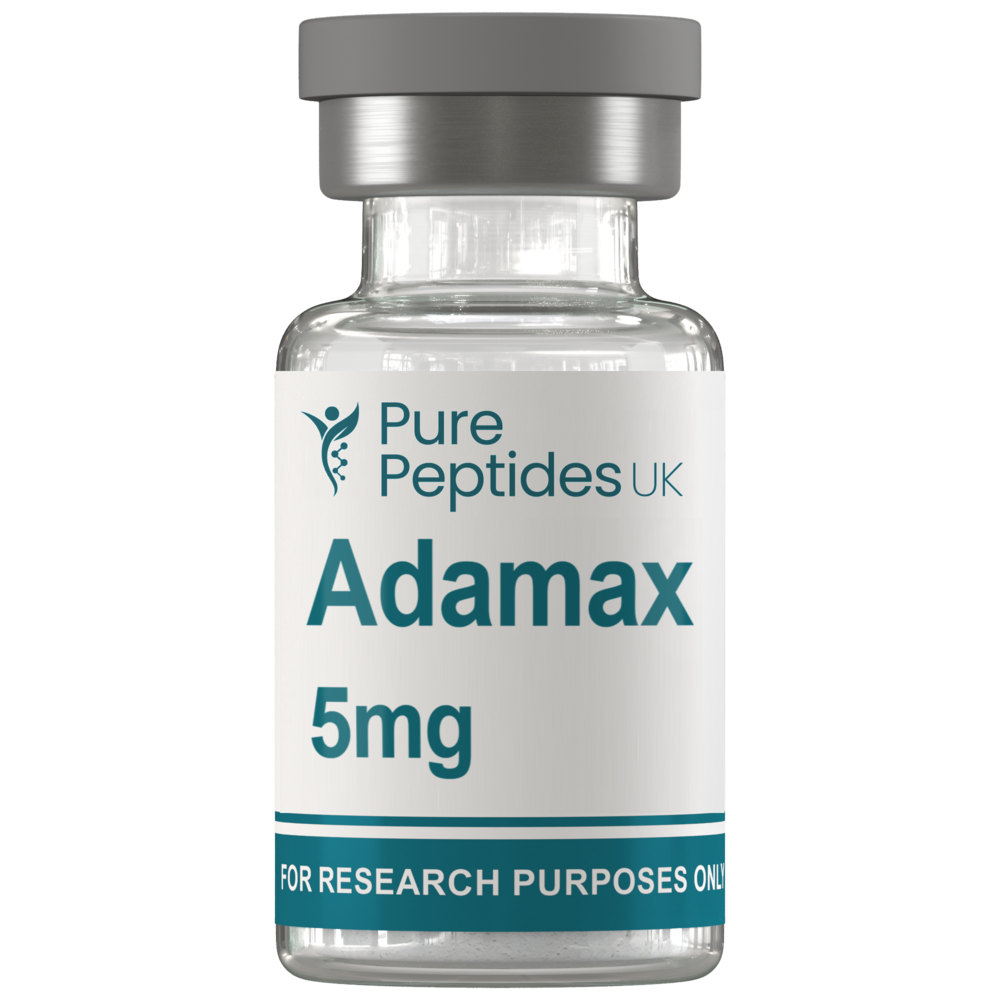
Adamax 5mg
Adamax is a next-generation nootropic peptide, designed as a structurally enhanced analogue of Semax with significantly improved bioavailability, stability, and cognitive activity. Engineered with both an acetyl group and an adamantane moiety, Adamax exhibits superior blood-brain barrier permeability, allowing for deeper central nervous system (CNS) activity and more sustained nootropic effects compared to its parent compound.
Adamax has become a prominent subject of research in neuroscience and cognitive enhancement studies due to its influence on key neuroplasticity mechanisms, particularly its ability to upregulate Brain-Derived Neurotrophic Factor (BDNF) and enhance TrkB receptor sensitivity in the hippocampus—a brain region critical for memory consolidation and emotional regulation.
Research Focus and Areas of Interest
1. BDNF Expression and Neuroplasticity Support
BDNF is one of the most extensively studied neurotrophins in the brain, known for its role in:
-
Promoting synaptic plasticity and neuronal survival
-
Supporting learning and memory formation
-
Facilitating neurogenesis in the hippocampus
Adamax has been shown in research settings to significantly elevate BDNF levels and enhance the signalling efficiency of its primary receptor, TrkB. These properties make it a valuable peptide in studies of neuroplasticity, cognitive resilience, and long-term memory encoding.
2. TrkB Receptor Sensitivity and Cognitive Signalling
Beyond BDNF expression, Adamax is studied for its modulation of TrkB receptor dynamics. Increases in TrkB sensitivity have been associated with:
-
Improved signal transduction in brain regions tied to cognition
-
Greater response to endogenous neurotrophins
-
Enhanced performance in models of executive function and emotional regulation
This dual impact on both BDNF output and receptor responsiveness places Adamax at the forefront of experimental cognitive enhancement peptides.
3. Structural Modifications and Bioavailability
Adamax’s improved performance over Semax is largely attributed to its chemical structure:
-
N-acetylation enhances peptide stability, helping it resist enzymatic breakdown
-
The adamantane group significantly increases lipophilicity, promoting efficient blood-brain barrier penetration
-
Together, these modifications result in higher central bioavailability and a longer duration of cognitive effect
Researchers value these enhancements when exploring Adamax’s efficacy and precision in CNS-targeted investigations.
4. Neuromodulation and Cognitive Research
Adamax is widely used in research investigating:
-
Working memory, focus, and learning retention
-
Stress resilience and emotional regulation
-
Age-related cognitive decline and neuroadaptive signalling
Its effect profile makes it a strong candidate for ongoing studies into nootropic peptides and neuroregenerative support compounds.
Conclusion
Adamax 5mg is a highly refined nootropic peptide, building on the foundation of Semax while introducing critical structural enhancements for improved brain bioactivity. With its ability to influence BDNF expression, TrkB receptor sensitivity, and overall neuroplastic signalling, Adamax continues to attract attention in the field of cognitive enhancement, memory research, and neuromodulation studies.
For research use only. Not approved for human or veterinary applications.
Technical Information:
• Synonyms: Adamax Peptide, Ac-Semax-Ad, Semax Adamantyl analogue
• Modified Single-Letter Amino Acid Sequence: Ac-MEHFPGP-Ad-NH₂ (provisional, pending full disclosure)
• IUPAC Condensed Amino Acid Sequence: Ac-Met-Glu-His-Phe-Pro-Gly-Pro-Ad-NH₂ (with adamantyl group modification at C-terminal)
• Molecular Weight: Approx. 1100–1300 g/mol (depending on adamantyl configuration)
• CAS Number: Not yet assigned (research analogue)
• PubChem CID: Not available for modified form
• PubChem URL: Not available
Stability: Store lyophilised protein at -20°c. Aliquot the product after reconstitution to avoid repeated freezing/thawing cycles. Reconstituted protein can be stored at 4°c for a limited period of time. The lyophilised protein remains stable until expiry date when stored at -20°c. For more information about storage, click here
Source: Biosynthesis
Reconstitution: Reconstitute with Bacteriostatic Water
Usage: Product is prepared for LABORATORY RESEARCH ONLY. Adamax for sale at Pure Peptides UK is limited to scientific research and education only – Only buy Adamax if you are a licenced researcher.
* Images for illustration purposes only
Reviews
There are no reviews yet